
 @samuelhumeImagesMedicine5 questions
Painful shins and swollen ankles: five clinical questions
One clinical case from skin and chest imaging to laboratory interpretation, guideline lookup and patient communication.
What you get
GPT-6.2 Astra95%
Open the full runQ4Right
The respiratory team considers her presentation highly characteristic of Löfgren syndrome. She has no particular infection or malignancy risk factors, and reliable follow-up is available. Use your search or browsing tool to find and open the official 2020 American Thoracic Society guideline on diagnosing sarcoidosis. Give the source link and the relevant recommendation heading. Should this patient undergo lymph-node sampling now? State the recommendation’s strength, the quality of the evidence and the follow-up it calls for. How does the advice differ for someone whose only finding is asymptomatic bilateral hilar lymphadenopathy?
Its answer
No—defer lymph-node sampling now. For patients with high clinical suspicion of sarcoidosis, the ATS specifically cites Löfgren syndrome and suggests not sampling lymph nodes. This is a conditional recommendation based on very low-quality evidence. Her characteristic presentation and lack of particular infection or malignancy risk factors favor deferral, but the guideline calls for close clinical follow-up. Revisit sampling if her course becomes atypical. For asymptomatic bilateral hilar lymphadenopathy alone, the ATS makes no recommendation for or against lymph-node sa…
A good answer says
Links to the official 2020 ATS diagnostic guideline (publisher, DOI or full-text repository). Identifies Lymph Node Sampling in the summary of recommendations or equivalent guideline section. Recommends deferring sampling given high clinical suspicion for Löfgren syndrome. Identifies a conditional recommendation. Identifies very low quality of evidence. Requires close clinical follow-up. For isolated asymptomatic bilateral hilar lymphadenopathy ATS makes no recommendation for or against sampling.
Q5Partly right
The team plans close follow-up and has deferred a biopsy for now. The patient asks, “I came in because my legs hurt. Now you’re telling me the glands in my chest are enlarged. Does that mean cancer? If you’re not doing a biopsy, how will you know you were right?” Reply directly to her in four sentences or fewer.
Its answer
Enlarged lymph nodes in your chest don’t automatically mean cancer; inflammation can cause both swollen nodes and leg pain. We think inflammation is more likely, but we can’t be certain yet. Rather than do a biopsy now, we’ll check how you’re feeling and repeat the chest imaging to see whether the nodes shrink. Improvement would support our explanation; if the nodes persist or grow, or your symptoms worsen, we’ll reconsider a biopsy.
A good answer says
Connects the shin, ankle and chest findings in plain language. Explains that the combination points toward sarcoidosis, an inflammatory condition. Addresses cancer concern without guaranteeing certainty. Explains what follow-up checks and when worsening findings would prompt reconsideration of biopsy.
Results so far

Questions 5
- Q1Short answerDermatologyIntermediate
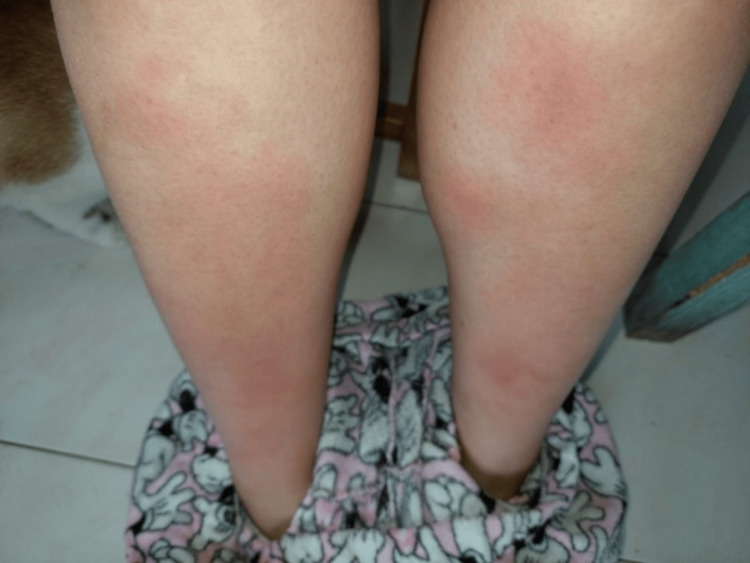
A 27-year-old woman presents with painful lumps on both shins. They developed over several days and are tender to pressure. Describe the dominant lesion and its distribution. What is the most likely eruption?
Peixoto et al., Cureus (2024), doi:10.7759/cureus.59597. CC BY 4.0. Figure 1. Rubric
- +1Tender erythematous nodules.
- +1Anterior lower legs or shins.
- +1Identifies erythema nodosum.
Show answer
Reference answer Tender erythematous nodules. Anterior lower legs or shins. Identifies erythema nodosum.
Source Peixoto et al., Cureus (2024), doi:10.7759/cureus.59597. CC BY 4.0.
- Q2Short answerRadiologyIntermediate
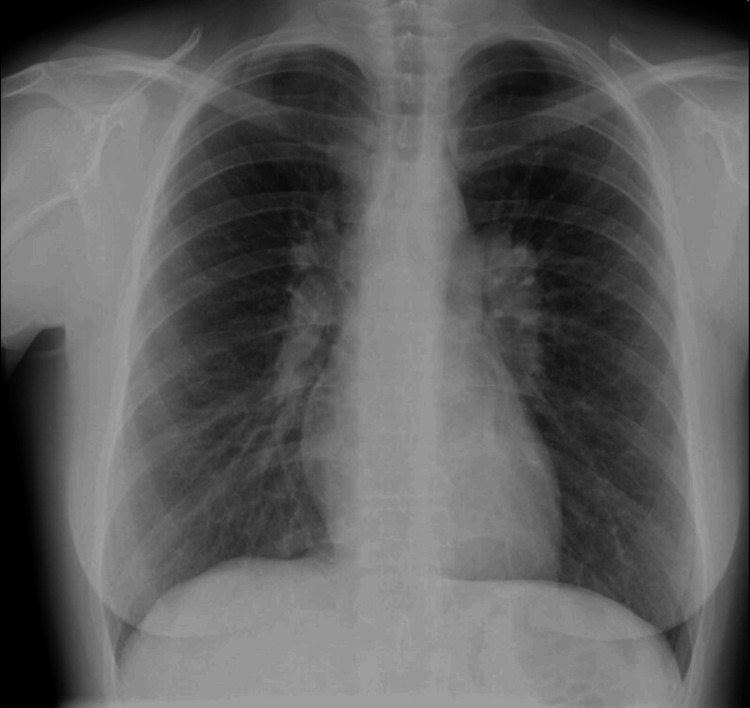
Two weeks later, both ankles are swollen and walking is painful. She has no cough or breathlessness. Her clinician obtains this chest X-ray. Write one sentence of findings and one sentence of impression. Identify the dominant abnormality, its distribution, and whether there is convincing focal air-space consolidation.
Peixoto et al., Cureus (2024), doi:10.7759/cureus.59597. CC BY 4.0. Figure 3. Rubric
- +1Hilar enlargement or fullness.
- +1Bilateral distribution.
- +1Suggests hilar lymphadenopathy.
- +1No convincing focal air-space consolidation.
Show answer
Reference answer Hilar enlargement or fullness. Bilateral distribution. Suggests hilar lymphadenopathy. No convincing focal air-space consolidation.
Source Peixoto et al., Cureus (2024), doi:10.7759/cureus.59597. CC BY 4.0.
- Q3Short answerInternal medicineAdvanced
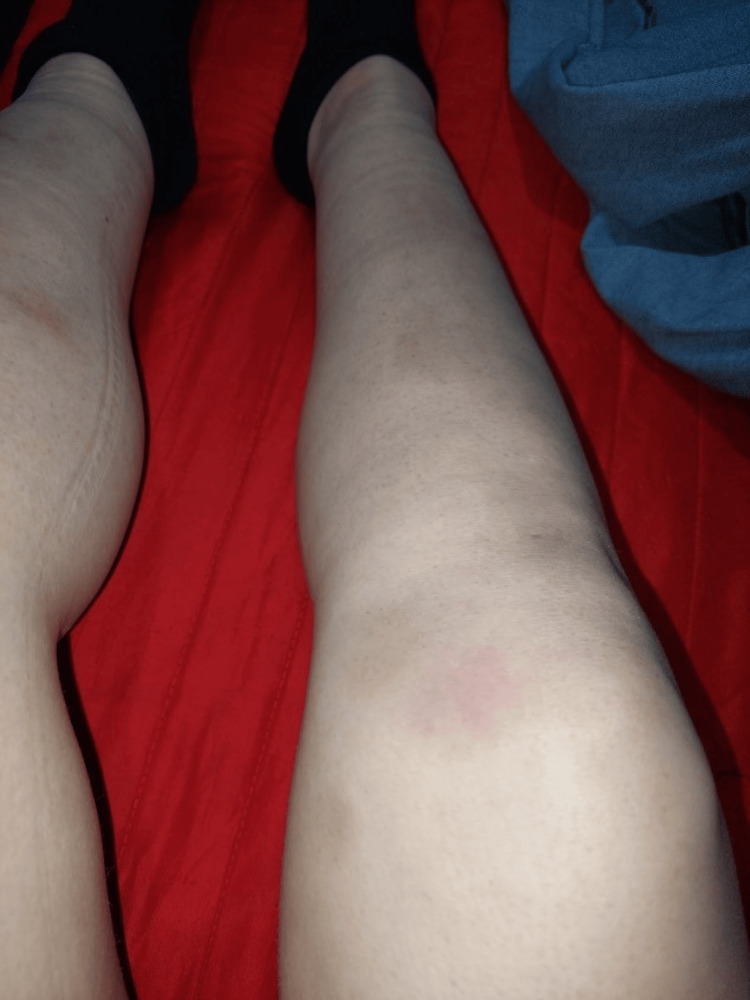
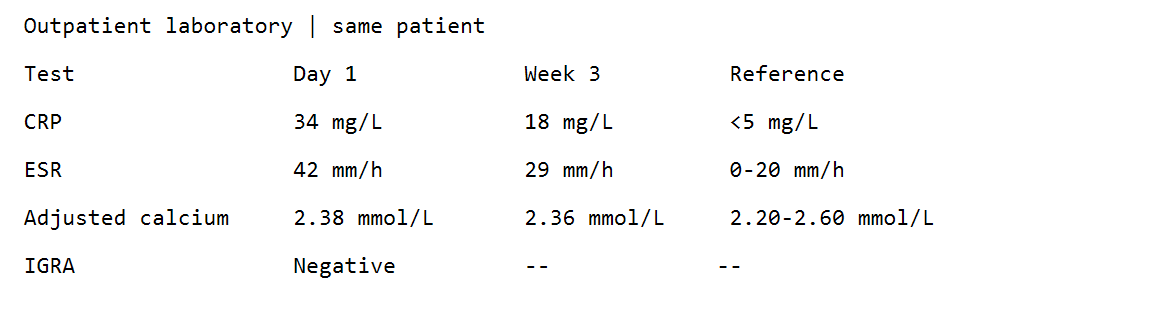
At her three-week review, the shin lesions are still tender and both ankles remain swollen. Review the skin and ankle photographs, the chest X-ray and the lab sheet together. A colleague says, “Her calcium is normal, so sarcoidosis is unlikely. Her TB blood test is negative, so we can cross tuberculosis off the list.” What is your leading diagnosis? Give the three findings that support it, then assess each of your colleague’s claims using the patient’s results.
Peixoto et al., Cureus (2024), doi:10.7759/cureus.59597. CC BY 4.0. Figure 1. Peixoto et al., Cureus (2024), doi:10.7759/cureus.59597. CC BY 4.0. Figure 2. Peixoto et al., Cureus (2024), doi:10.7759/cureus.59597. CC BY 4.0. Figure 3. Original simulated laboratory report. Rubric
- +1Identifies Löfgren syndrome.
- +1Cites erythema nodosum.
- +1Cites bilateral ankle inflammation.
- +1Cites bilateral hilar lymphadenopathy.
- +1Interprets normal week-three adjusted calcium of 2.36 mmol/L as compatible with sarcoidosis.
- +1Explains that the negative IGRA cannot by itself exclude active TB.
Show answer
Reference answer Identifies Löfgren syndrome. Cites erythema nodosum. Cites bilateral ankle inflammation. Cites bilateral hilar lymphadenopathy. Interprets normal week-three adjusted calcium of 2.36 mmol/L as compatible with sarcoidosis. Explains that the negative IGRA cannot by itself exclude active TB.
Source Peixoto et al., Cureus (2024), doi:10.7759/cureus.59597. CC BY 4.0. Original simulated lab sheet. CDC IGRA interpretation guidance.
- Q4Short answerEvidence-based respiratory medicineAdvanced
The respiratory team considers her presentation highly characteristic of Löfgren syndrome. She has no particular infection or malignancy risk factors, and reliable follow-up is available. Use your search or browsing tool to find and open the official 2020 American Thoracic Society guideline on diagnosing sarcoidosis. Give the source link and the relevant recommendation heading. Should this patient undergo lymph-node sampling now? State the recommendation’s strength, the quality of the evidence and the follow-up it calls for. How does the advice differ for someone whose only finding is asymptomatic bilateral hilar lymphadenopathy?
Rubric
- +1Links to the official 2020 ATS diagnostic guideline (publisher, DOI or full-text repository).
- +1Identifies Lymph Node Sampling in the summary of recommendations or equivalent guideline section.
- +1Recommends deferring sampling given high clinical suspicion for Löfgren syndrome.
- +1Identifies a conditional recommendation.
- +1Identifies very low quality of evidence.
- +1Requires close clinical follow-up.
- +1For isolated asymptomatic bilateral hilar lymphadenopathy ATS makes no recommendation for or against sampling.
Show answer
Reference answer Links to the official 2020 ATS diagnostic guideline (publisher, DOI or full-text repository). Identifies Lymph Node Sampling in the summary of recommendations or equivalent guideline section. Recommends deferring sampling given high clinical suspicion for Löfgren syndrome. Identifies a conditional recommendation. Identifies very low quality of evidence. Requires close clinical follow-up. For isolated asymptomatic bilateral hilar lymphadenopathy ATS makes no recommendation for or against sampling.
Source ATS, Diagnosis and Detection of Sarcoidosis (2020), doi:10.1164/rccm.202002-0251ST.
- Q5Short answerPatient communicationIntermediate
The team plans close follow-up and has deferred a biopsy for now. The patient asks, “I came in because my legs hurt. Now you’re telling me the glands in my chest are enlarged. Does that mean cancer? If you’re not doing a biopsy, how will you know you were right?” Reply directly to her in four sentences or fewer.
Rubric
- +1Connects the shin, ankle and chest findings in plain language.
- +1Explains that the combination points toward sarcoidosis, an inflammatory condition.
- +1Addresses cancer concern without guaranteeing certainty.
- +1Explains what follow-up checks and when worsening findings would prompt reconsideration of biopsy.
Show answer
Reference answer Connects the shin, ankle and chest findings in plain language. Explains that the combination points toward sarcoidosis, an inflammatory condition. Addresses cancer concern without guaranteeing certainty. Explains what follow-up checks and when worsening findings would prompt reconsideration of biopsy.
Source ATS, Diagnosis and Detection of Sarcoidosis (2020), doi:10.1164/rccm.202002-0251ST.
See how your model does.
RunHands-on records 0
No hands-on records yet.
Log a hands-on recordAbout
- License
- CC BY 4.0